Coburg North, Melbourne — Serving All of Victoria
If you’re searching for commercial exhaust fan sizing in Melbourne, you’re usually dealing with one of two problems: smoke that won’t leave, or a fan that’s loud, expensive to run, and still doesn’t capture properly. The “right” fan size isn’t just airflow — it’s airflow at the right static pressure, matched to your canopy, duct route, and cooking load.
This guide breaks down the practical sizing logic so you can get a correct specification faster — whether you’re fitting out a new venue or troubleshooting an existing system.
A correctly sized exhaust system does three jobs:
Most “bad fans” are actually bad matches — the fan, canopy, duct, and filters are working against each other.
You can’t size a fan properly from “it’s a 2-metre canopy”. You need these five inputs:
List each appliance and what it does (grill, fryer, wok, combi, charcoal, pizza, etc.). High-plume cooking needs more capture performance than light-duty lines.
Wall canopy, island, eyebrow, low-profile — it matters. Depth, overhang, and mounting height can make or break capture.
If you’re still deciding, start here: commercial kitchen canopy selection guide.
A short, straight duct run is a totally different system to a long run with multiple elbows and transitions. Every turn and restriction adds resistance (static pressure).
Filters protect the duct, but they also add pressure drop. Dirty filters add more. That’s why a system can “work” for a week after a clean, then fall over again.
Rooftop discharge near neighbours, tenancy boundaries, or outside air intakes matters. In many Melbourne sites, directing discharge upward and away helps reduce re-entry and rooftop turbulence. That’s where vertical discharge fans often suit the job.
Here’s the simplest way to think about it:
A fan that looks “big enough” on airflow can still fail if duct resistance is higher than expected. That’s why the system must be sized as a whole — not as parts.
Oversizing can create:
Often the smarter solution is speed control: a VSD controller lets the fan run to demand rather than full speed all day.
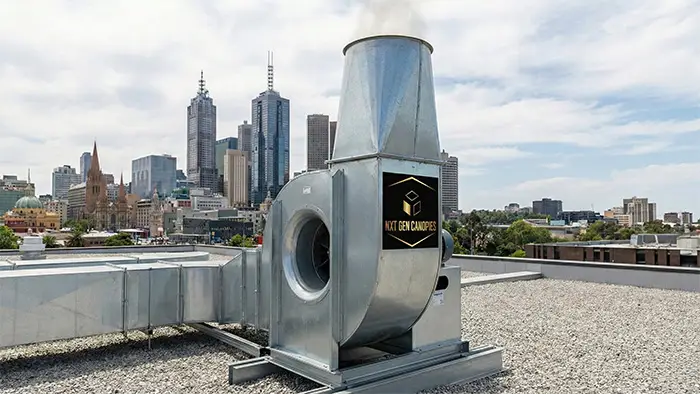
Best when you need to push exhaust up and away from rooflines and nearby air intakes, and you want a clean rooftop discharge strategy. See vertical discharge fan options.
Often stronger where you have longer duct runs, higher resistance, or you need stable performance against static pressure.
Rule of thumb: the “best” fan is the one that still delivers performance when real duct losses are counted — not the one with the biggest headline number.
When you’re ready, request a quote here: get a compliant quote.
| Variable | What it impacts | What goes wrong if ignored |
|---|---|---|
| Cooking duty (plume strength) | Capture requirement | Smoke roll-out, greasy walls |
| Canopy height & overhang | Containment | “Fan runs but kitchen still smokes” |
| Duct length & elbows | Static pressure | Weak pull, noisy airflow |
| Filter type & cleanliness | Pressure drop | Performance falls over time |
| Discharge constraints | Recirculation / odour | Smell complaints, re-entry |
For Victorian projects, the safest approach is to treat the canopy, ductwork, and fan as one system and size it properly from day one — it avoids costly rework during approvals and commissioning.
If you’re at the approvals stage, this helps: commercial kitchen council approval in Victoria.
If your kitchen has quiet periods (most do), a VSD controller can reduce speed during prep and ramp up during peak service — lowering noise and running costs while keeping performance where it needs to be.
Want this sized correctly the first time? Send your cookline + rough duct sketch and we’ll recommend the right fan type and control approach.
Get a compliant quote from NXT GEN Canopies or learn more about our process: installation and manufacturing.
If smoke rolls out at the canopy edge, the kitchen stays hazy during peak service, or performance drops quickly after filter loading, the fan may be under-delivering against your system resistance.
No. Many smoke issues are caused by canopy geometry, mounting height, or duct resistance. Bigger can increase noise and cost without improving capture.
Static pressure is the resistance in the duct system. The fan must overcome it to deliver real airflow at the hood.
Often, yes — especially where you need discharge directed upward to reduce re-entry near rooflines and nearby air intakes. See vertical discharge fans.
If your cooking load varies, a VSD can reduce noise and energy use by matching fan speed to demand. See VSD controllers.