Coburg North, Melbourne — Serving All of Victoria
At a glance
Commercial kitchen canopy cost in Melbourne depends on six variables: size, canopy type, material grade, included accessories, fan and ductwork, and installation complexity. Standard wall-mounted canopies sit at the affordable end; custom designs, marine-grade stainless, and integrated fire suppression push the number higher. The $20,000 instant asset write-off applies to each item separately until 30 June 2026.
Pricing is the single biggest question Melbourne café, restaurant, and commercial kitchen operators ask before requesting a quote. Most manufacturer websites won't put numbers anywhere on a public page, leaving you to guess whether you're being quoted fairly. This guide takes a different approach — instead of headline prices that go stale every time steel prices shift, we walk through the variables that actually drive the cost, so you can sense-check any quote you receive against the underlying logic.
Below we break down what determines the real commercial kitchen canopy cost Melbourne operators face in 2026, where standard pricing stops and custom quoting starts, and how the current instant asset write-off changes the after-tax position. For specific numbers on your project, send us your equipment list and we'll come back same-day with a quote.
Canopy pricing is not a single number because no two kitchens are identical. The cost of a commercial kitchen canopy is built from six variables, and understanding them lets you predict where your quote will land before you ask for it.
Canopies are priced by length, depth, and height. A 1500 mm single-bank canopy sits at the bottom of the range; a 3000 mm double-bank canopy over a full cooking line sits at the top. Every additional 300 mm of length adds a meaningful jump in materials and labour because more stainless steel, more filter banks, more grease troughs, and more lighting are required. Depth matters too — a deeper canopy captures more grease-laden vapour but uses more steel.
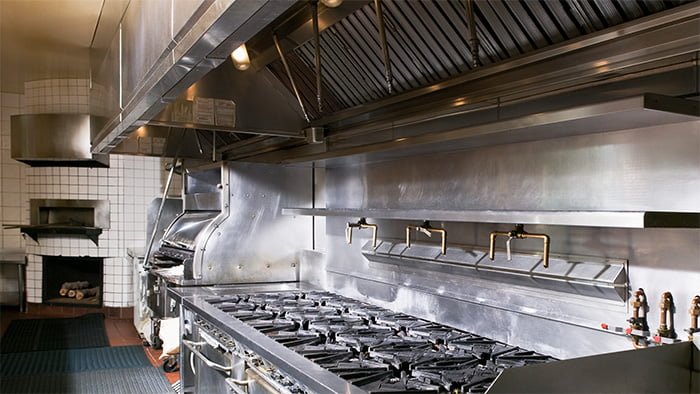
Different cooking processes need different canopy designs. A standard wall-mounted canopy is the most affordable because it's a proven, repeatable build. Specialty canopies — condensate hoods for pizza ovens, double filter banks for heavy-grease cookers, tapered hoods for food trucks, island canopies — cost noticeably more because of additional fabrication steps, internal components, and structural reinforcement.
Grade 304 stainless steel at 1.2 mm is the industry baseline and what NXT GEN uses as standard. Grade 316 (marine-grade) for coastal kitchens or fish-handling environments adds a premium because of the molybdenum content. Heavier 1.5 mm gauge for high-heat char-grill applications adds further cost. Anything thinner than 1.2 mm isn't worth the saving — it warps under heat and fails council inspection. Always check the spec sheet on any quote, not just the headline price.
Aluminium honeycomb filters, stainless baffle filters, grease drain plugs, and LED canopy lights are either included as standard or added as upgrades. A canopy with basic galvanised baffle filters costs less than the same size with aluminium honeycomb filters plus LED lights, but the upgrade pack substantially improves grease capture and lighting performance. We covered why these upgrades matter in our essential canopy upgrades guide.
The canopy itself is only part of the system. You also need an appropriately sized exhaust fan, matching ductwork, a vertical discharge stack, and often a VSD controller for NCC Part J6 compliance on systems above 1,000 L/s. The fan and ductwork together typically account for a substantial portion of the total system cost — sometimes more than the canopy itself on simpler installs. Our commercial exhaust fan sizing guide walks through how to match the fan to the canopy.
Installation cost depends on your building. A straightforward ground-floor café with a flat roof above is the cheapest install scenario. A multi-storey fit-out with long horizontal duct runs, complex roof access, and structural penetrations is the most expensive. Every elbow in the ductwork, every metre of additional duct, and every storey above ground level adds time and materials. Body corporate approvals on strata-titled buildings can also add weeks to the timeline, which has its own cost implications.
NXT GEN publishes pricing on standard sizes through our canopy shop — which almost no Melbourne competitor does. Standard canopies cover the most common kitchen layouts and let operators see what they're paying for upfront. The shop covers wall-mounted units in popular lengths from 1500 mm up to 3000 mm in 304-grade 1.2 mm stainless steel, with baffle filters, grease trough, drain plug, single LED light, and ducting collar ready for fan connection.
Custom pricing kicks in when your kitchen can't use a standard size or shape. The most common reasons to go custom in Melbourne include:
Custom builds typically cost meaningfully more than the nearest standard equivalent, but the gap closes on larger jobs where the proportional fabrication time is similar.
If you've collected quotes from two or three Melbourne canopy suppliers, the spread between them can look bewildering. The headline numbers might differ substantially — but that gap is rarely a "good vs bad price" story. It's almost always a specification difference hiding under similar-looking line items.
The variables that explain most quote differences:
When comparing quotes, ask each supplier to itemise the specification at this level. The cheapest quote at the same spec is genuinely cheaper. The cheapest quote at a different spec is a different product entirely.
The $20,000 instant asset write-off applies to each asset separately — not per project — which is why an exhaust canopy system is almost always fully deductible in the year of installation. A canopy, an exhaust fan, a VSD controller, and LED lights purchased together are individually under the threshold and each fully deductible.
The deadline matters: equipment must be installed and ready for use by 30 June 2026. Simply ordering or paying a deposit before the deadline doesn't qualify. From 1 July 2026, the threshold drops back to $1,000 unless the federal government extends it — which it hasn't committed to. We've covered the full EOFY timeline and tax rules in our EOFY 2026 canopy tax guide.
Ready for a real Melbourne quote with transparent specifications?
A quick phone quote on a canopy almost always lands wrong — either you're quoted too low and the number climbs once you start answering questions, or too high as a defensive measure. Giving your supplier five pieces of information up front makes for a quote that holds:
We covered the five most important questions to ask before signing any canopy contract in our pre-contract checklist. Operators who use it tend to get better final pricing than those who don't, because they're comparing like-for-like quotes.
NXT GEN manufactures in Coburg North and services all of Victoria including Melbourne CBD, northern suburbs, western suburbs, eastern suburbs, south east Melbourne, Geelong, Ballarat, and Bendigo. Standard canopies from our shop ship within a week. Custom builds typically run 2–3 weeks in the factory. Installation is usually booked 1–2 weeks after manufacture completes, though we can move faster on confirmed EOFY projects.
Commercial kitchen canopy cost in Melbourne varies based on size, material grade, included accessories, fan, ductwork, and installation complexity. A standard 304-grade stainless wall-mounted canopy for a typical café cooking line sits at the affordable end. Custom builds with marine-grade stainless or integrated fire suppression cost more. Most operators find the canopy itself is roughly 40–55% of the total system cost once fan, ductwork, and installation are added. Send us your equipment list for a real quote.
Yes. Commercial exhaust canopies are depreciating assets eligible for the small business instant asset write-off. For the 2025–26 financial year, assets costing under $20,000 (ex-GST for GST-registered businesses with aggregated turnover under $10 million) can be fully deducted in the year of installation. All standard NXT GEN canopies fall under this threshold.
Canopy quotes vary because of material grade, stainless thickness, included accessories, warranty length, and how installation is priced. A cheaper canopy and a more expensive canopy of the same size are rarely equivalent — the difference is usually 0.9 mm versus 1.2 mm stainless, baffle versus honeycomb filters, single versus multiple LED lights, and whether a drain plug is included. Always compare the full specification, not just the headline price.
No. Our shop prices are for the canopy ex-factory. Installation is quoted separately because it depends entirely on your site — ductwork length, roof access, ceiling height, and electrical complexity all change the labour number.
The entry point for a compliant commercial canopy in Melbourne is a standard 1500 mm wall-mounted unit in 304-grade stainless steel at 1.2 mm gauge with baffle filters and grease trough. Anything cheaper is usually either a residential hood rebranded for commercial use (not compliant) or built from thinner gauge material that won't pass council inspection. The cost of replacing a non-compliant canopy within six months is far higher than the saving.
Yes. Most Melbourne business finance brokers offer chattel mortgages on commercial kitchen equipment, and chattel-mortgaged assets still qualify for the instant asset write-off. Operating leases generally don't qualify because you don't own the asset. Speak to your accountant before financing to confirm the structure keeps the tax benefit intact.
A well-built 304 stainless canopy with regular cleaning and maintenance will last 15–25 years. The canopy body itself rarely fails — what usually needs replacing first is the fan, filters, LED lights, and controllers. This makes the per-year cost of a quality canopy genuinely low, which is why the cheapest quote is almost never the cheapest system over its service life.