Coburg North, Melbourne — Serving All of Victoria
At a glance
Commercial kitchen ventilation in winter behaves differently from summer. Cold make-up air, heaters fighting against exhaust, condensation in flues, and seasonal grease build-up all change how your canopy performs. This 12-point checklist covers what to check before peak winter trading — most fixes take under an hour, save real money on heating bills, and prevent the slammed-door symptom that wrecks service.
Melbourne winter is when commercial kitchens find out whether their ventilation system was designed properly or just installed cheaply. Cold incoming air, indoor heaters running at full tilt, condensation forming inside flues, and seasonally heavier grease cooking all combine to expose weaknesses that summer hides.
The kitchens that sail through winter are the ones that did a 30-minute pre-winter check in April or May. The ones that don't end up calling for emergency service in July when the fan fails or doors start slamming during dinner service. This guide walks through the 12-point commercial kitchen ventilation winter checklist we recommend operators run before mid-May each year.
Four things change in winter that compound on each other:
A system that passed inspection last summer can fail in winter for none of these reasons individually but all of them together. The fix is preventative, not reactive.
Run this checklist in the second-to-last week of April or the first week of May. Most items take 5–10 minutes. Anything that fails goes on a fix list with priority by how much it'll cost you in winter trading hours if it breaks during service.
Turn on your exhaust fan on its highest setting. Walk through the kitchen to the closest external door. If it slams shut on its own or requires real force to open from outside, you have negative pressure — and that gets worse in winter when sealed buildings have nowhere for replacement air to enter from. AS 1668.2 requires make-up air at 65–85% of exhaust flow. If you've never measured it, you don't know.
Listen to the rooftop or wall-mounted fan from outside. New bearings hum quietly. End-of-life bearings rattle, grind, or whine at higher pitches. A fan that's noisier in April than it was last October won't make it through winter peak. We covered the diagnostic in our noisy commercial exhaust fans guide.
Pull each filter and inspect both faces. AS 1851-2012 specifies cleaning before grease deposit reaches 2 mm. Hold a filter to the light — if you can't see daylight through baffles or honeycomb cells, it's overdue. Replace any filter that's deformed, has corroded mesh, or has missing baffles. Damaged filters drop capture efficiency by 30–50% without you noticing.
Open the canopy access panel and check the grease collection trough. Empty if more than half full. Check the 25 mm drain plug seal — winter condensation mixed with grease accumulates faster than dry grease alone. If the plug is sticky or the seal looks compressed flat, replace the gasket.
Check that all ductwork inspection access panels open and close cleanly. They're commonly painted shut, screwed into permanent positions, or buried behind subsequent renovations. AS 1851-2012 requires accessible inspection — if a fire compliance audit hits in winter and the panels won't open, the kitchen gets shut.
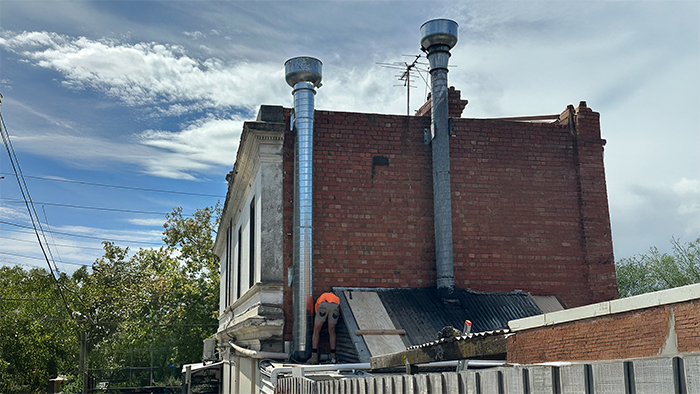
From outside the building, look at the vertical exhaust stack on the roof. Confirm the weather cap is intact and free of bird nests, leaves, and debris. Winter storms blow more debris into stacks than summer winds — a partially blocked discharge cap reduces exhaust capacity and can backdraft into the kitchen on windy nights.
Test every canopy light. Winter service runs longer hours into darker afternoons and earlier evenings. A canopy light that fails in mid-July gets replaced under stress, often outside warranty. Replace any LED that's dimmer than its neighbours — driver failure usually shows as gradual dimming before outright failure.
If you have a VSD (Variable Speed Drive) controller — mandatory on systems above 1,000 L/s under NCC Part J6 — confirm it ramps up and down smoothly. Stuck-on-high VSDs blow heating budgets; stuck-on-low VSDs starve the canopy. A VSD that doesn't respond to demand has either a failed sensor or a worn-out drive that needs replacement before winter peak.
Dedicated make-up air units typically have a heating element for tempering cold incoming air. Test the heater. Inspect the supply filter (a clogged supply filter is as bad as a clogged exhaust filter — both kill flow). If your kitchen uses door and window transfer instead of a dedicated unit, plan for winter draft management — staff comfort drops fast at 7am when the kitchen door is the only make-up air path.
Type 5 cooking (char grills, BBQs, tandoori) requires factory-fitted fire suppression under AS 1668.2:2024. AS 1851-2012 requires 6-monthly fire suppression service. Check the service tag — winter peak is the worst time for an out-of-date suppression system to be flagged by a fire compliance audit. Book the service now if it's due before October.
Make sure you can produce the canopy's installation documentation, the mechanical engineer's design certificate (if required), and the most recent cleaning record. Winter is council inspection season — operators near tourist precincts get checked before the school holiday rush. Missing documentation is the easiest way to fail an otherwise compliant kitchen. See our council approval guide for Victoria for what to keep on file.
Brief the kitchen team on what to report in winter. The signals are different from summer: doors slamming during evening service, blue burner flames lifting off the cooktop, condensation dripping from canopy edges, unusual fan noise audible inside the kitchen. Staff who know what to look for catch problems in week one instead of week six.
If your kitchen's heating bill spikes more than expected in July compared to last winter, the canopy is the prime suspect — even if it seems to be working fine. Here's the dynamic: your exhaust fan pulls about 600–2,000 L/s of conditioned air out of the kitchen every second it runs. That air has to be replaced. If the building isn't sealed enough, replacement air enters through every gap, door, and window — at outdoor temperature.
Your heating system then has to warm all of that air. A 1,500 L/s exhaust running for an 8-hour service shift moves roughly 43 million litres of air through the kitchen. If that air enters at 8°C and needs to reach 22°C, the heating load is enormous — and most of it gets sucked back out the canopy immediately.
The fixes:
Found 3 or more issues on the checklist? Time for a pre-winter service quote.
The 12-point checklist above is a kitchen manager's job — observations and condition checks. Anything beyond that needs a qualified ventilation specialist. Specifically:
If your post-checklist fix list runs to more than three items in those categories, the cheapest move is a single pre-winter service call where one tradesperson does everything in one trip — versus three separate emergency callouts in July when the kitchen is full.
A practical timeline for getting through winter without surprises:
Yes. Cold outside make-up air, indoor heating fighting the exhaust flow, condensation forming inside ductwork, and heavier cooking patterns all change canopy behaviour in winter. Systems that work well in February can struggle in July if they were sized tight, if make-up air balance is off, or if filters and fans were already at end-of-life heading into winter.
Because the exhaust fan pulls heated kitchen air outside continuously, and that air has to be replaced with outside air at outdoor temperature. Without a tempered make-up air unit, your heaters end up heating the outdoors. A typical 1,500 L/s exhaust moves enough air through the kitchen during a winter service to be equivalent to replacing the room's entire air volume every 2–3 minutes. Solutions include installing a tempered make-up air supply, confirming your VSD is reducing fan speed during off-peak, and sealing kitchen-to-dining leaks.
Late April to early May is ideal. Cleaning and minor service take 1–2 weeks to schedule in autumn but stretch to 4–6 weeks if you wait until late May or June, because everyone else realises winter is coming at the same time. Fire suppression services and VSD repairs have similar seasonal demand patterns.
Negative pressure. Your exhaust fan is pulling more air out of the kitchen than make-up air can enter. The closest doors and windows become the only path for replacement air, which is why they slam. This gets worse in winter because heated kitchens sit in well-sealed buildings. The fix is either reducing exhaust capacity (rare) or increasing make-up air supply (more common — usually via a dedicated supply fan or by opening up transfer paths from adjacent spaces).
Filters are cleaned, not replaced, on a regular schedule under AS 1851-2012 — cleaning is required before grease deposit reaches 2 mm. Replacement is needed when filters are physically damaged (deformed mesh, missing baffles, corrosion). Aluminium honeycomb filters typically last 5–10 years with proper cleaning. Baffle filters in stainless typically last 10+ years. Both should be inspected each pre-winter check.
The 12-point checklist itself is an observational walk-through that any kitchen manager can run. Fixes that involve ductwork cleaning, fan motor service, three-phase electrical work, fire suppression service, or commissioning of make-up air units must be done by qualified tradespeople. DIY ductwork cleaning specifically can void insurance policies — AS 1851-2012 requires certified-technician documentation.