Coburg North, Melbourne — Serving All of Victoria
At a glance
Baffle vs honeycomb filter in commercial kitchens is mostly a service-life vs upfront-cost trade-off. Honeycomb filters are cheaper to buy and pull air through with less restriction — they suit most cafés and standard restaurants. Stainless baffle filters cost more upfront but last decades, and they're the right choice over char grills and any open-flame cooking where fire risk is highest. Baffles come in aluminium (cheaper) or stainless (longer-lasting); honeycomb is aluminium only.
When you're specifying a commercial kitchen canopy in Melbourne, the filter choice is the single most influential decision on day-to-day cleaning workload and long-term grease management. Get it right and your canopy stays compliant with the AS 1851-2012 cleaning schedule with minimal staff effort. Get it wrong and you'll either pay for replacement filters every couple of years or fight fire-risk issues over high-heat cooking.
This guide compares the two filter types you'll actually be choosing between — baffle vs honeycomb filter — covers how each works, the grease capture mechanics, cleaning frequency, lifespan, and which one suits which cooking style. We also explain why baffles are the only correct choice over char grills, and why galvanised steel baffle filters keep getting quoted by cheap suppliers despite being non-compliant for commercial use.
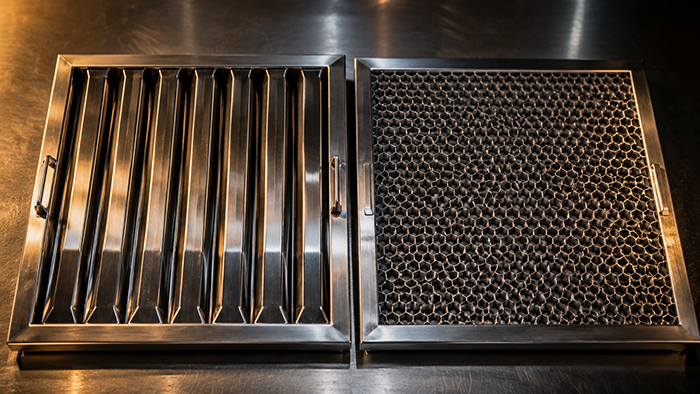
A baffle filter is a series of overlapping vertical S-shaped or Z-shaped metal vanes set inside a frame. As grease-laden air enters the canopy, the vanes force the air to change direction sharply — usually three or four times — within the filter body.
Grease droplets have more mass than air molecules. When the airflow changes direction, the air follows the path but the grease droplets can't — inertia carries them straight into the next vane. The grease hits the metal, condenses, and runs down to the bottom of the filter and into the canopy's grease gutter below.
Baffles come in two material grades, and the difference matters:
Other key characteristics of baffle filters generally:
An aluminium honeycomb filter is a dense matrix of small hexagonal aluminium cells, typically 3–10 mm across, packed into a stainless steel frame at a depth of around 50 mm. Air passing through the filter has to navigate through thousands of small passages.
Grease capture works two ways: first, the small cell openings force air into many parallel paths that change direction multiple times (the same inertial impaction as baffle filters but at higher density). Second, the large internal surface area of the honeycomb gives grease droplets many more opportunities to contact metal and condense. Captured grease drains down through the cells and into the canopy gutter the same way baffle filters work.
Key characteristics of aluminium honeycomb filters:
| Property | Baffle (aluminium or stainless) | Aluminium honeycomb |
|---|---|---|
| Construction | Vertical S/Z vanes in stainless frame | Hexagonal aluminium cells in stainless frame |
| Material options | Aluminium (cheaper) or stainless steel (longer-life) | Aluminium only |
| Grease capture rate | Good | Higher per square metre |
| Drainage to gutter | Self-draining | Self-draining |
| Pressure drop on fan | Higher (more restriction) | Lower (less restriction) |
| Suitable for open-flame cooking | Yes — the required choice for char grills, BBQs, solid fuel | No — must not be used over open flame |
| Cleaning frequency | Weekly to fortnightly typical | Weekly minimum, often more |
| Dishwasher safe | Yes | Yes, with care — chemicals degrade aluminium over time |
| Service life | Stainless 15–20+ years; aluminium baffle a bit less | 2–4 years depending on cleaning frequency |
| Damage resistance | Excellent — survives impact and dropping | Moderate — honeycomb cells can deform on impact |
| Upfront cost | Higher (especially stainless) | Lower |
| Total cost over 10 years | Lower — no replacement cycle | Higher — 2–4 replacement cycles in that period |
The filter choice comes down to two things: whether your cooking line includes open-flame equipment, and whether you'd rather spend less upfront or less over the long run. Here's the decision framework we use at NXT GEN when specifying filters:
The only scenario where mixing filter types under one canopy makes sense is when the canopy covers both open-flame and non-flame cooking on the same line. The section directly above the char grill, BBQ, or tandoor gets stainless baffle filters for fire safety. The section above the rest of the cookline can use honeycomb if upfront cost matters or pressure drop is tight.
For everything else, pick one filter type and run it across the whole canopy — mixing for any other reason creates a cleaning workflow nightmare with no real benefit.
The double filter bank approach takes this further by stacking two filter banks vertically — the first bank handles the bulk of grease capture, the second bank polishes whatever passes the first. We covered this in our double filter bank canopy guide.
If you're collecting quotes and one supplier comes in significantly cheaper than the rest, check whether their canopy is fitted with galvanised steel baffle filters instead of aluminium or stainless. Galvanised baffles look almost identical to stainless when new. Six months later the difference is brutal.
Galvanised steel is mild steel coated in zinc. In a commercial kitchen environment — heat, moisture, grease, cleaning chemicals — the zinc coating breaks down within months. Once the zinc is gone, the underlying steel rusts. Rust contaminates the grease gutter, gets pulled into the airstream, and forms rough surfaces inside the filter that grease sticks to far more aggressively than smooth aluminium or stainless.
Galvanised filters fail a Food Act 1984 inspection in Victoria because corroded metal in a food preparation area is a contamination risk. They also fail AS 1851-2012 cleaning verification because rusted baffles can't be properly cleaned to specification. Replacing them within 12–18 months almost always costs more than specifying aluminium or stainless baffles from day one.
Always confirm filter material on any quote. The line item should specifically say "aluminium baffle filters", "stainless steel baffle filters" or "aluminium honeycomb filters in stainless steel frame". If it just says "baffle filters" with no material specification, ask the question — and reject any quote that comes back as galvanised.
Both filter types can be cleaned in a commercial dishwasher with degreasing detergent — but the cleaning intervals and technique differ.
Remove filters from the canopy weekly to fortnightly depending on cooking volume. Pre-soak in hot water with commercial degreaser for 20–30 minutes. Run through a commercial dishwasher on its hottest cycle. The S-shaped vanes drain readily during the wash. Inspect for damage — bent vanes or compressed frames reduce capture efficiency.
Remove weekly minimum (more often for heavy-grease cooking). Soak in hot water with degreaser for 30–45 minutes — longer than baffles because the dense matrix needs more time for the degreaser to penetrate. Avoid harsh alkaline detergents that aggressively attack aluminium; use a degreaser formulated for kitchen filter use. The choice of cleaning chemical has a big effect on whether your honeycomb lasts 2 years or 4. Run dishwasher cycle, then inspect — honeycomb cells deformed during handling significantly reduce capture rate.
For both filter types, AS 1851-2012 requires cleaning before grease deposit reaches 2 mm thickness. Document each cleaning date — operators get asked for this by insurance during claims and by Food Act inspectors during audits.
Not sure which filter type your kitchen needs?
Switching between filter types on an existing canopy is usually straightforward — most filter types use the same standard slot dimensions and frame mounting. The exception is older canopies with non-standard slots, where bespoke replacements are needed.
Two considerations before upgrading filters on an existing canopy:
We also covered why upgrading the canopy's other components matters when you upgrade filters in our essential canopy upgrades guide.
Neither is universally better — they suit different cooking types and budgets. Stainless baffle filters are tougher, last 15–20+ years, and are the only correct choice over char grills and open-flame cooking. Aluminium honeycomb filters are cheaper upfront, have lower pressure drop on the fan, and suit standard non-flame cooking — but they need replacing every 2–4 years. For a typical Melbourne café without a char grill, honeycomb is usually the more economical choice. For any kitchen with open-flame cooking, stainless baffles are required.
Yes, on upfront cost. Aluminium honeycomb filters are typically the cheapest option, aluminium baffle filters sit in the middle, and stainless steel baffle filters are the most expensive. Over a 10-year span the picture flips — honeycomb filters need replacing every 2–4 years, so their total cost across 10 years often exceeds a single set of stainless baffles that lasts the whole period.
AS 1851-2012 requires cleaning before grease deposit reaches 2 mm. In practice, baffle filters in a moderate-volume café need cleaning weekly to fortnightly. Honeycomb filters and any filter in heavy-grease cooking need cleaning at least weekly, sometimes more often during peak service periods. Documenting each cleaning date in a maintenance log is a legal requirement under AS 1851 and often requested by insurers.
Yes for both baffle and aluminium honeycomb filters — they're designed for commercial dishwasher cleaning with degreasing detergent. Pre-soak in hot water with degreaser for 20–45 minutes before the dishwasher cycle, depending on grease loading. Avoid harsh alkaline detergents on aluminium components (both aluminium baffles and honeycomb) as repeated exposure shortens service life.
No — galvanised steel baffle filters fail multiple compliance requirements in commercial kitchens. The zinc coating breaks down in heat, moisture, and cleaning chemicals, leading to rust within 6–12 months. Rusted filters fail Food Act 1984 contamination requirements in Victoria, fail AS 1851-2012 cleaning verification, and contaminate the grease gutter. Always specify aluminium baffle, stainless steel baffle, or aluminium honeycomb filters — galvanised options should be rejected on any commercial quote.
Stainless steel baffle filters typically last 15–20+ years with regular cleaning. Aluminium baffle filters last slightly less. Aluminium honeycomb filters typically last 2–4 years depending on how frequently they're cleaned and what cleaning chemicals are used — alkaline detergents shorten honeycomb life significantly. All filter types should be inspected for deformed vanes/cells, warped frames, and visible corrosion at each cleaning.
Stainless steel baffle filters. They're the only filter type rated for direct exposure to open flame and the high heat output of char grills, BBQs, tandoor ovens, lava rock grills, and solid-fuel cooking. Aluminium honeycomb filters must not be used over open-flame cooking — the dense aluminium matrix is a fire risk and the filter itself will degrade rapidly under direct flame exposure.
Yes. Baffle filters create more restriction in the airflow because the S/Z vanes force the air through several sharp direction changes. Honeycomb filters offer many parallel cell paths, allowing air to flow through with less resistance. The pressure-drop difference matters if your exhaust fan was sized tight — switching from honeycomb to baffle on a marginal system can reduce extraction below the AS 1668.2 minimum.