Coburg North, Melbourne — Serving All of Victoria
At a glance
When ordering replacement canopy filters, record both outside frame dimensions, the frame depth and the number required. Photograph the filter and its fitted position, and confirm that the replacement suits the canopy and cooking equipment. Matching the visible face size alone is not enough to establish fit or suitability.
A replacement filter can look right in a catalogue and still be wrong for your canopy. The frame might be too deep for the retaining channel, the quoted size might use a different convention, or the filter type might not suit the cooking beneath it.
A few measurements and clear photographs make the ordering conversation much easier. This guide covers how to prepare those details for replacement commercial canopy filters, including NXT GEN's aluminium honeycomb options.
Start with the existing filter and any available manufacturer information. Record the material, filter construction and identifying labels. Photograph its front, back and frame, plus the canopy with the filters in place.
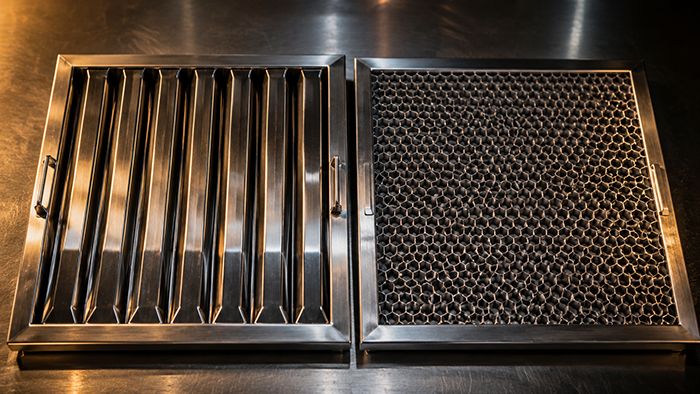
Our baffle and honeycomb filter comparison discusses the different types. For replacement ordering, the key question is whether the proposed filter is suitable for your particular canopy and cooking use. Do not assume two filters are interchangeable because their frames appear similar.
If the cooking equipment has changed since the canopy was installed, include that in your enquiry. A replacement order is a good point to raise the change with the supplier before buying the same component again.
Follow the equipment instructions for safe removal. Plan the measurement when cooking has stopped, the equipment has cooled and the relevant isolation procedure has been followed. If safe access is difficult, arrange for the appropriate person to inspect it rather than climbing on cooking equipment.
Measure the complete outside frame in millimetres. Record both face dimensions and the frame depth separately. A photograph of the tape measure against each dimension helps the supplier understand exactly what has been measured.
| Detail | What to record | Why it helps |
|---|---|---|
| First face dimension | Outside edge to outside edge of the complete frame. | Avoids confusing the filter media opening with the overall size. |
| Second face dimension | The other outside frame dimension, with the fitted orientation noted. | Shows the complete face size without relying on an ambiguous width/height label. |
| Frame depth | The full frame thickness from front to back. | Helps check fit in the canopy’s retaining arrangement. |
| Frame details | Handles, edges, drainage features and any labels, supported by photos. | Identifies details a face measurement does not show. |
| Quantity | The number required and whether all positions use the same size. | Avoids assuming every filter in a bank is identical. |
Measure an undamaged filter where possible. A bent frame may no longer represent the intended size. If all filters are damaged or missing, send photos and the canopy details so the supplier can advise what needs checking.
Product descriptions do not always present dimensions in the same order. Read the complete specification and compare it with your measurements. Do not round a measured dimension up or down just to make it match a product name.
NXT GEN's aluminium honeycomb filter product lists 394 × 495 × 50 mm. Treat that as a specification to check, not a universal size for commercial canopies. If your measurements or the existing label differ, confirm compatibility before purchase.
The individual aluminium honeycomb filter and box of six honeycomb filters have separate listings. Use the quantity option that suits your confirmed requirements; buying a box does not establish that every filter position is the same.
Have measurements but are unsure about the fit? Include photos of the frame and canopy in your enquiry.
A frame that fits physically still needs to be the appropriate filter for the installation. Tell the supplier what equipment is under the canopy and whether you are replacing like for like or proposing a change of filter type.
Changing filter construction can affect the exhaust system's resistance and operation. Discuss a proposed change with the supplier or ventilation contractor before ordering. Replacing filters is not a substitute for investigating an exhaust system that is struggling to capture cooking fumes.
Do not trim a frame, leave gaps or remove filters to make an unsuitable order work. Ask for the correct replacement and follow the manufacturer's fitting instructions. Missing or insecure filters need attention before the system is returned to normal cooking use.
Inspect the frame and filter media during routine cleaning. Bent frames, loose components, visible deterioration and damage that prevents the filter sitting securely are reasons to seek replacement advice.
Grease loading alone does not tell you the remaining life of a filter. Follow the manufacturer's cleaning method and chemical guidance, then assess its condition. Avoid promising a fixed replacement interval without considering the product and how it has been used.
If the kitchen still has smoke or heat problems after routine maintenance, arrange a broader assessment. The filters are only one part of the system. Our exhaust fan guide provides background for a discussion with the contractor; ordering a different filter should not be treated as a guaranteed airflow fix.
For example, an enquiry saying “six filters, measured frame 394 × 495 mm, depth 50 mm, with photos attached” gives the supplier much more to work with than “standard café filters”. It still needs the suitability check, but the dimensions and quantity are clear.
Browse NXT GEN's canopy components and accessories once the size and filter type are confirmed. If there is a mismatch between your measurements and the listing, send Liam the details before placing the order.
Record both outside dimensions of the complete frame and its depth in millimetres. Note the fitted orientation and photograph each measurement. Follow the equipment instructions for safe access and removal.
No. Compare the actual frame dimensions, depth and fitting details with the replacement specification. Do not assume a filter will fit because it is described as standard or looks similar.
The individual and box-of-six product listings specify 394 × 495 × 50 mm. Check those dimensions against your existing filter and confirm suitability for your canopy and cooking equipment before ordering.
Do not make the change based on frame size alone. Ask the supplier or ventilation contractor to confirm suitability for the cooking equipment and exhaust system, including any effect on airflow resistance.
NXT GEN lists aluminium honeycomb filters individually and in boxes of six. Confirm the specification and number needed, then check the relevant product listing for current price and availability.
Do not rely on a distorted frame as the intended size. Send canopy details and photographs to the supplier, who can advise what measurements or inspection are needed to identify the replacement.