Coburg North, Melbourne — Serving All of Victoria
At a glance
A well-built stainless canopy lasts 15–25 years, but several things end its life early: rust and corrosion, a failing fan, smoke and grease that won't clear, and falling out of compliance with the current AS 1668.2:2024 standard. This guide covers the nine clearest signs it's time to replace rather than repair — plus how the EOFY 2026 instant asset write-off makes replacing before 30 June a smart move.
Commercial kitchen canopies don't usually fail all at once. They degrade slowly, and most operators keep patching a tired system long past the point where replacement would have been cheaper and safer. Knowing the signs of a commercial canopy replacement situation helps you plan the spend instead of being forced into an emergency replacement mid-service.
Below are the nine clearest signals that a canopy has reached end of life, why each one matters, and how to weigh repair against replacement. We also cover the EOFY 2026 angle — there's a genuine tax reason to replace before 30 June if your canopy is on the way out anyway.
A quality 304 stainless steel canopy, properly cleaned and maintained, lasts 15–25 years. The canopy body itself — the stainless shell and capture hood — rarely wears out within that window. What tends to fail earlier is the supporting equipment: the exhaust fan (8–12 years), filters (ongoing replacement), LED lights (5–10 years), and controllers.
This matters for the repair-vs-replace decision. If the canopy body is sound but the fan has failed, you replace the fan. If the canopy body itself is corroding, undersized for current compliance, or structurally tired, that's when full replacement makes sense. The nine signs below help you tell which situation you're in.
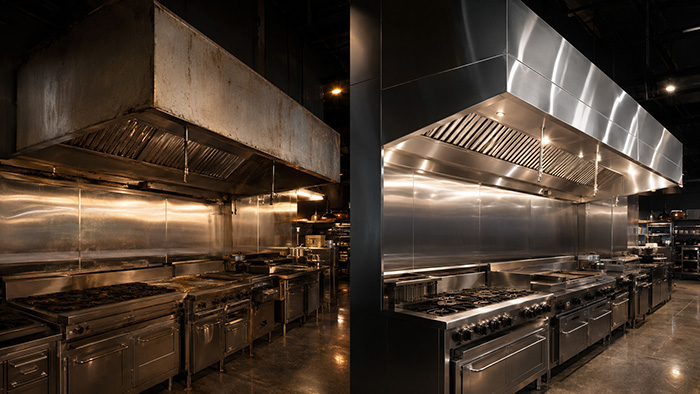
Surface rust on a stainless canopy is a warning sign. Genuine 304 or 316 stainless shouldn't rust under normal kitchen conditions — visible corrosion usually means the canopy was built from a lower grade (430 stainless or worse, galvanised steel) that's now breaking down. Once rust appears in the grease gutter or on the capture surfaces, it contaminates food preparation areas and fails Food Act 1984 requirements in Victoria. Rust can't be reliably repaired on a structural canopy; it spreads. This is a clear replacement trigger.
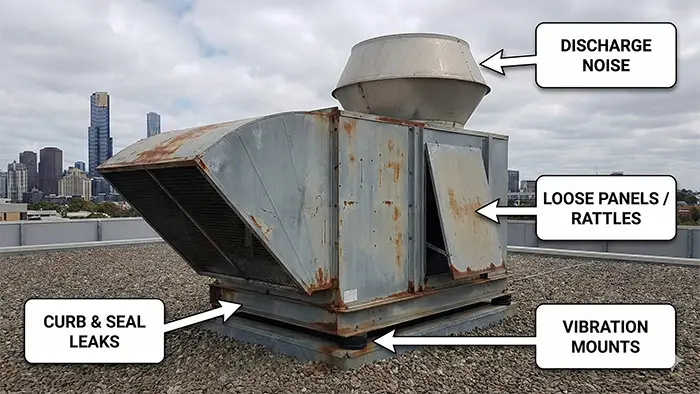
A grinding, rattling, or whining fan is near the end of its bearings. If the fan has already failed, you're not legally trading until it's fixed. A single fan replacement can be worth it on an otherwise-sound canopy, but if the fan failure coincides with other signs on this list, full system replacement is usually the better spend. We covered fan diagnosis in our noisy exhaust fans guide.
If smoke lingers in the kitchen or spills out the sides of the canopy despite clean filters and a working fan, the canopy has lost capture performance. This can be age, a fan that no longer delivers its rated airflow, or a canopy that was always undersized. When a canopy can't do its core job, no amount of cleaning fixes it — the capture geometry or the airflow is the problem, and that means replacement or major rework.
The mechanical ventilation standard was updated in November 2024, and the requirements for overhang, exhaust flow, and process-type classification are more demanding than older editions. A canopy installed under an earlier standard may not comply if you change your cooking equipment, undergo a major refurbishment, or get reassessed by a building surveyor. If your kitchen is being brought up to current standard, replacing the canopy is often more cost-effective than trying to modify an old one. Our AS 1668.2:2024 guide explains what changed.
A canopy is sized for the cooking process types beneath it. If you're adding a char grill to a line that previously only had gas ranges, or installing woks where there were fryers, the existing canopy may no longer have the right overhang or exhaust capacity for the new cooking type. Adding higher-emission equipment (moving up the AS 1668.2 process-type scale) frequently means the old canopy is now undersized. Our sizing guide shows how equipment type drives canopy size.
Grease dripping from the canopy onto the cooking line or floor means the grease gutter, drain, or capture geometry is failing. On an older canopy this is often because the gutter has corroded, the drain plug seal has perished, or the whole system was poorly fabricated to begin with. Persistent grease leaks are both a slip hazard and a fire risk, and on a tired canopy they signal that the fabrication is breaking down.
If a fire safety audit flags your canopy — ductwork that can't be properly cleaned, missing or non-compliant fire suppression on Type 5 cooking, or inaccessible inspection points — and the fixes are extensive, replacement can be cheaper than retrofitting compliance onto an old system. A canopy that repeatedly fails AS 1851-2012 cleaning verification because its surfaces can't be cleaned to specification has reached end of life.
When you're calling for service every few months — a new fan motor, then a controller, then a light, then a gutter repair — the cumulative cost starts to approach a new canopy. There's a tipping point where continuing to repair an old system costs more over two years than replacing it once. If your maintenance log shows escalating callouts, do the maths on replacement.
Some kitchens inherit a canopy from a previous tenant that was never properly compliant — a residential rangehood pressed into commercial service, an undersized hood, or a DIY install. If you've taken over a site and discovered the canopy doesn't meet commercial standards, replacement isn't optional. It's the difference between passing and failing your council inspection. Our council approval guide covers what inspectors check.
Recognise a few of these signs? Get a replacement quote before EOFY.
Not every problem means replacement. Use this rule of thumb:
| Situation | Usual answer |
|---|---|
| Sound stainless body, failed fan only | Repair — replace the fan |
| Sound body, worn filters or lights | Repair — replace components |
| Rust or corrosion in the body/gutter | Replace |
| Undersized for current/new cooking type | Replace |
| No longer meets AS 1668.2:2024 | Replace (modification rarely cheaper) |
| Escalating repair costs over 1–2 years | Replace — do the cumulative maths |
| Never compliant / residential unit | Replace |
When several signs appear together — a tired fan plus some corrosion plus a compliance question — the cumulative case for replacement is usually decisive even if no single sign would force it alone.
A canopy replacement is more straightforward than a first-time install because the ductwork path, electrical, and roof penetrations usually already exist. A typical replacement involves removing the old canopy, assessing whether the existing ductwork and fan can be reused or need upgrading, fabricating the new canopy to the correct AS 1668.2:2024 size for your current cooking line, installing it, and connecting to the existing or upgraded services.
Where the existing fan and ductwork are sound, replacement can be quick. Where they've aged alongside the canopy, replacing the whole system at once is often the better long-term value — you reset the clock on everything and get a fully compliant, warrantied system. For the cost considerations, see our canopy cost guide.
A quality 304 stainless steel canopy, properly cleaned and maintained, lasts 15–25 years. The stainless body rarely wears out in that window. The supporting equipment fails sooner — exhaust fans last 8–12 years, LED lights 5–10 years, and filters are replaced on an ongoing basis. This is why a failed fan on a sound canopy is usually a repair, while a corroded or undersized body is a replacement.
Repair when the stainless body is sound and only a component has failed — a fan, filters, lights, or a controller. Replace when the body itself is corroding, when the canopy is undersized for your current or new cooking equipment, when it no longer meets AS 1668.2:2024, or when repair costs are escalating year on year. When several of these appear together, replacement is usually the better value even if no single one would force it.
Genuine 304 or 316 stainless steel shouldn't rust under normal commercial kitchen conditions. Visible rust usually means the canopy was built from a lower grade — 430 stainless, or galvanised steel marketed as stainless — that's now corroding. Once rust appears in the grease gutter or capture surfaces it contaminates food preparation areas and fails Food Act 1984 requirements in Victoria. Rust on a structural canopy spreads and can't be reliably repaired, so it's a clear replacement trigger.
Possibly. A canopy is sized for the cooking process types beneath it under AS 1668.2:2024. Adding higher-emission equipment — a char grill where there were gas ranges, or woks where there were fryers — moves you up the process-type scale and often means the existing canopy no longer has enough overhang or exhaust capacity. Before changing equipment, check whether your current canopy still complies with the new cooking type.
Yes. A replacement commercial canopy is a depreciating asset eligible for the instant asset write-off. For the 2025–26 financial year, assets under $20,000 (ex-GST for GST-registered businesses with aggregated turnover under $10 million) can be fully deducted in the year of installation, provided the canopy is installed and ready for use by 30 June 2026. From 1 July 2026 the threshold drops to $1,000 unless extended, so replacing a failing canopy before EOFY captures the full deduction.
Less than a first-time install, because the ductwork path, electrical, and roof penetrations usually already exist. The old canopy is removed, the existing services are assessed for reuse, the new canopy is fabricated to the correct current-standard size, and it's connected to the existing or upgraded ductwork and fan. Where services are sound the changeover is quick; where they've aged with the canopy, replacing the system together is often better value and resets the warranty on everything.