Coburg North, Melbourne — Serving All of Victoria
At a glance
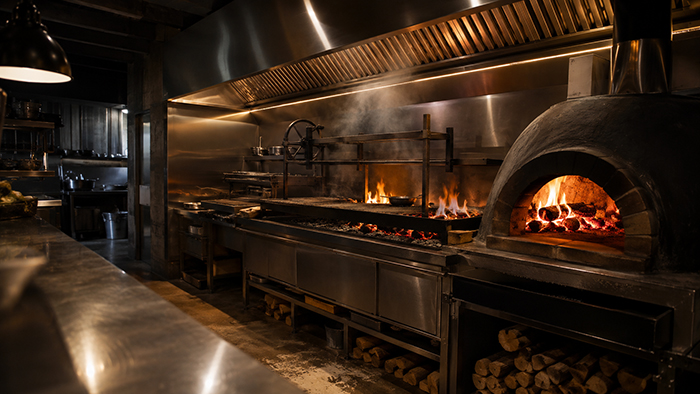
Char-grills, wood-fired ovens and other solid-fuel cooking throw off more heat, more grease, more smoke and — critically — live sparks and embers that a standard baffle canopy is not built to handle. Solid fuel is classed as heavy or extra-heavy duty under AS 1668.2, so it needs a higher extraction rate, spark-arrestor filters, and usually its own dedicated exhaust system separate from the gas equipment. For high-grease operations a water-wash canopy earns its keep. Get the canopy right and you cut the biggest fire risk in the kitchen; get it wrong and grease-lined ductwork plus stray embers is exactly how kitchen fires start.
Wood-fired pizza, charcoal-grilled steak, yakitori, tandoor and asado have made solid-fuel cooking one of the strongest trends in Melbourne hospitality. But the canopy that works perfectly over a gas range is the wrong tool over a bed of glowing charcoal. Solid fuel changes the physics — hotter effluent, heavier grease, thicker smoke, and burning embers travelling up into the filters — and the ventilation has to change with it.
This guide explains why char-grill and wood-fired exhaust canopies are built differently, what features solid fuel demands, and how to keep a solid-fuel kitchen safe and compliant.
Gas and electric appliances produce a fairly clean, predictable stream of hot, grease-laden air. Solid fuel — charcoal, lump wood, briquettes — adds four problems on top:
Put together, these mean a solid-fuel canopy has to pull harder, trap embers before they reach grease, tolerate more heat, and shed grease more aggressively than a standard canopy ever needs to.
AS 1668.2 classifies cooking equipment by "duty" — how much heat and effluent it produces — and sets the exhaust rate accordingly. Solid-fuel appliances sit at the top of that scale:
| Cooking duty | Typical equipment | Extraction demand |
|---|---|---|
| Light | Ovens, steamers, bains-marie | Lowest |
| Medium | Ranges, fryers, griddles | Moderate |
| Heavy | Char-grills, upright broilers | High |
| Extra-heavy | Solid-fuel and wood-fired appliances | Highest |
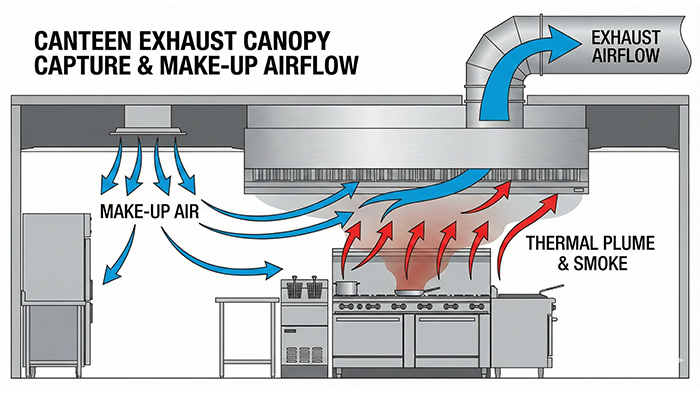
Because solid fuel sits in the heavy-to-extra-heavy band, it needs a higher exhaust airflow per metre of canopy than gas equipment, plus enough canopy overhang to catch the wider, hotter, smokier plume. Undersize it and smoke rolls out into the dining room; that calculation is the core of our canopy sizing guide. A higher exhaust rate also has to be balanced by more supply air, which is why solid-fuel kitchens make correct make-up air non-negotiable.
The single most important addition. Spark-arrestor baffles are designed to intercept live embers and force the airflow through a path that lets sparks burn out or drop before they reach the grease-laden duct. On a solid-fuel canopy they are not optional — they are the barrier between an ember and a duct fire.
Best practice — and commonly a requirement — is that solid-fuel appliances exhaust through their own dedicated canopy and duct, separate from the gas and electric equipment. This keeps embers and the heavier grease load out of the general kitchen exhaust, makes cleaning more manageable, and means the solid-fuel line can be built to a higher fire specification without over-building the whole kitchen. If you're running a char-grill alongside a normal line, plan for two exhaust systems, not one.
A water-wash canopy has built-in spray nozzles that wash the filter bank with hot water and detergent on a cycle, continuously stripping grease from the extract path. For high-volume char-grilling and wood-fired cooking it does two valuable things: it keeps grease from accumulating where embers could ignite it, and it slashes the manual cleaning burden on a system that would otherwise clog fast. The upfront cost is higher than a standard baffle canopy, but for a serious solid-fuel operation the fire-risk reduction and reduced cleaning downtime usually justify it.
Because the effluent is hotter and the ignition risk higher, solid-fuel exhaust ductwork needs appropriate fire rating, generous access panels for cleaning, and careful clearance from combustible building elements. A wet-chemical fire-suppression system over the cooking line and into the canopy is strongly recommended for solid fuel and is often a condition of insurance or council approval. Suppression, ductwork and canopy should be designed together.
The extra heat and grease reward a robustly built canopy in heavier-gauge 304 stainless steel, with fully welded, sealed grease gutters that drain properly. Our note on why stainless steel is best for a commercial exhaust canopy covers the material choice.
Adding a char-grill, wood-fired oven or smoker? Let's build the right canopy for it.
| Standard baffle | Water-wash | |
|---|---|---|
| Grease handling | Manual filter cleaning | Automatic wash cycle strips grease continuously |
| Fire risk | Higher — grease accumulates near embers | Lower — extract path kept clean |
| Cleaning labour | Frequent manual work | Much reduced |
| Upfront cost | Lower | Higher |
| Best for | Lighter or occasional solid-fuel use | High-volume char-grill and wood-fired lines |
Solid fuel builds grease and creosote in the filters and ductwork faster than gas cooking, so a solid-fuel exhaust needs cleaning more often. Cleaning frequency for commercial kitchen exhaust systems is guided by AS 1851, and heavy solid-fuel use sits at the frequent end of that range. Regular professional cleaning of the canopy, filters and full duct run — not just the filters you can see — is what actually keeps a solid-fuel kitchen from becoming a fire statistic. Watch for the signs your canopy needs attention and keep it on a strict maintenance schedule.
Purpose-built solid-fuel ventilation turns up wherever fire and smoke are part of the menu: steakhouses and charcoal grills, wood-fired pizzerias, smokehouses and barbecue joints, Argentinian parrilla and asado kitchens, Japanese yakitori and robata bars, Indian tandoor kitchens, and Korean barbecue. Wood-fired ovens sit alongside our condensate pizza canopy and combi oven canopy in our range of purpose-built canopies — each matched to how the equipment actually cooks.
You shouldn't. A standard baffle canopy has no defence against the live embers a char-grill throws upward, and those embers can ignite grease in the filters or duct. Solid fuel also produces more heat, grease and smoke than a standard canopy is sized for. A char-grill needs a canopy built for solid fuel — with spark-arrestor filters, a higher extraction rate, and ideally its own dedicated exhaust system.
Usually, yes. Best practice — and often a requirement — is to run solid-fuel appliances on a dedicated canopy and duct, kept separate from the gas and electric equipment. This keeps embers and the heavier grease load out of the general kitchen exhaust, simplifies cleaning, and lets the solid-fuel line be built to a higher fire specification. If you're combining a wood-fired oven with a normal cooking line, plan for two exhaust systems.
It's a baffle filter engineered to intercept live sparks and embers before they can travel up into the grease-laden ductwork. The airflow path is designed so embers lose energy and burn out or drop rather than carrying through. On any solid-fuel canopy, spark-arrestor filters are an essential fire-safety component, not an upgrade.
For a high-volume char-grill or wood-fired line, generally yes. A water-wash canopy automatically washes grease from the filter bank on a cycle, which keeps the extract path clean, cuts the fire risk from accumulated grease, and dramatically reduces manual cleaning downtime. It costs more upfront than a standard baffle canopy, but for a busy solid-fuel operation the safety and labour savings usually justify it. For lighter or occasional solid-fuel use, a spark-arrestor baffle canopy may be enough.
More often than a gas kitchen. Solid fuel deposits grease and creosote in the filters and ductwork faster, so cleaning sits at the frequent end of the AS 1851 range. The whole system needs professional cleaning — canopy, filters and the full duct run, not just the visible filters — because it's the hidden grease in the duct that fuels the worst kitchen fires. A strict, documented cleaning schedule is essential for solid-fuel kitchens.
It's strongly recommended and frequently required. A wet-chemical fire-suppression system covering the cooking line and canopy is standard practice for solid fuel because of the higher ignition risk, and it's often a condition of insurance or council approval. The suppression system, ductwork and canopy should all be designed together so the protection is matched to the equipment.