Coburg North, Melbourne — Serving All of Victoria
At a glance
Odour and smoke complaints are one of the fastest ways for a Melbourne food business to attract a council notice or an EPA Victoria pollution report. The fix is a layered exhaust system: grease filters capture the fat, an activated-carbon or electrostatic pollution-control (ecology) unit strips the smoke and smell, and a correctly designed vertical discharge throws whatever is left high and away from neighbours. Most complaints come down to one of three faults — no odour treatment fitted, a discharge point that is too low or capped, or a system that was never sized for char-grilling and frying. All three are fixable.
A commercial kitchen can pass its ventilation sign-off and still generate a stream of angry phone calls from the apartments upstairs. Capturing grease at the canopy and keeping the kitchen comfortable is one job; making sure the air leaving the building doesn't smell like last night's service is another job entirely — and it's the one that lands operators in front of the council.
As Melbourne fills with mixed-use developments where restaurants sit directly beneath residential apartments, kitchen exhaust odour and smoke control has gone from a nice-to-have to a make-or-break part of any fit-out. This guide explains why the problem happens, who regulates it, the technology that actually solves it, and what to do if a complaint has already landed.
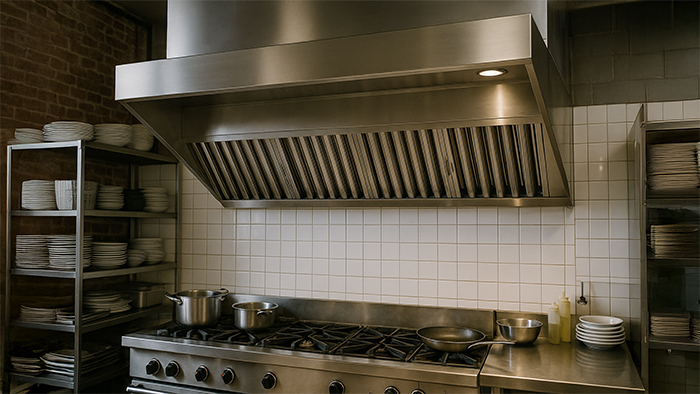
A standard exhaust canopy is designed to capture grease-laden vapour and remove it from the kitchen. Baffle filters do a good job on the grease droplets, but they do almost nothing to the fine smoke particles and the odour molecules riding in the airstream. Those pass straight through the filters, up the duct, and out the discharge point — still smelling exactly like char-grilled meat, fryer oil, or wok smoke.
In a standalone building with neighbours a long way off, that's rarely an issue. The trouble starts when three things line up:
When those overlap, the odour lands in someone's living room, and the complaint follows. In a new mixed-use development the residents were often there before the kitchen opened, which is exactly why councils now attach odour-management conditions to planning permits for food premises.
Three separate layers can apply to the same exhaust, and it's easy to satisfy one while breaching another.
The mechanical ventilation standard, AS 1668.2, sets where and how kitchen exhaust may be discharged: minimum separation distances from property boundaries, openable windows and fresh-air intakes, and the requirement to discharge vertically upward without a restrictive weather cap so the plume clears the roof. Your building surveyor checks this at permit stage. It's covered in our explainer on the 2024 Victorian kitchen regulations.
Under the Environment Protection Act 2017, every business carries a General Environmental Duty (GED): a legal obligation to minimise the risk of harm to human health and the environment from its activities, including offensive odour and smoke. A neighbour can report persistent odour to EPA Victoria, and "we passed our building permit" is not a defence against the GED. The duty is ongoing and outcome-based — if the smell is a problem, it's your responsibility to reduce it.
Councils control food premises through planning permits and can attach conditions requiring an odour-management or air-quality plan, particularly in mixed-use zones. They can also act on odour as a nuisance under public health legislation. In practice the council is usually the first body a resident contacts, and a council direction to fix an odour problem carries real weight. Our guide to commercial kitchen council approval in Victoria covers the permit side in detail.
Effective control is layered. Each stage removes something the previous stage couldn't, and you fit only the stages your cooking type demands. From first to last in the airstream:
| Stage | What it removes | When you need it |
|---|---|---|
| Baffle / mesh filters | Grease droplets and larger particles | Always — the first line of defence in every canopy |
| Electrostatic precipitator (ESP) | Fine smoke particulate and grease aerosol (typically 90–95%) | Visible smoke — char-grills, wood-fired, heavy frying |
| Activated carbon | Odour molecules (the actual smell) | Any close-neighbour or residential situation |
| UV / ozone | Breaks down grease and odour compounds | High grease and odour loads, added to an ESP/carbon unit |
| Discharge design | Disperses whatever remains high above neighbours | Always — and often the cheapest lever of all |
A pollution-control unit — also sold as an "ecology unit" — packages the ESP, carbon, and sometimes UV into a single in-line cabinet that sits between the canopy and the fan. For a Melbourne restaurant with residential neighbours, an ecology unit plus a good discharge is usually the complete answer. Grease is still handled at the canopy by baffle filters; see our comparison of baffle vs honeycomb filters for that first stage.
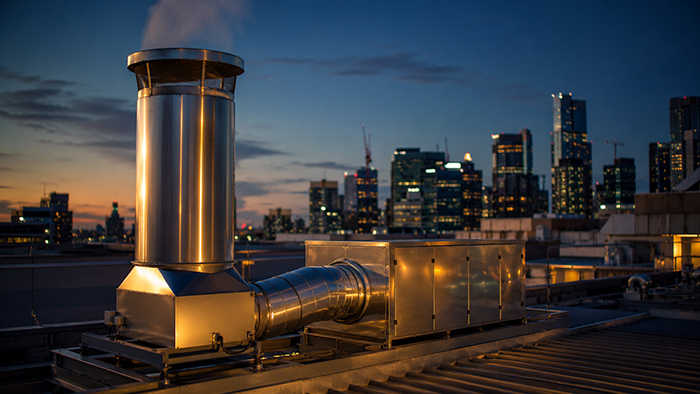
Before spending on filtration, it's worth checking the discharge, because it's often the cheapest and most effective single change. Four things matter:
Get the discharge right and a surprising number of "odour" complaints simply stop, because the smell is now being diluted high above the people who were noticing it. Filtration then handles the rest.
Getting odour complaints — or fitting out beneath apartments? Let's design the right system.
A complaint isn't a disaster, but ignoring it can become one. Work through it in order:
It is far cheaper to build odour control into a new kitchen than to retrofit it after residents complain. During design, the cooking equipment schedule tells you how much smoke and odour to expect, the exhaust is sized correctly from the outset, and the ecology unit and discharge are planned into the duct route rather than shoehorned in later. If the site sits beneath apartments, treat odour management as a core requirement — councils increasingly make it a permit condition anyway, and designing it in avoids an expensive fix down the track. Pairing efficient filtration with a well-designed system also keeps running costs down, as we cover in our guide to eco-friendly commercial kitchen ventilation.
Because grease filters and odour are two different problems. Baffle filters in the canopy capture grease droplets, but the fine smoke particles and the odour molecules pass straight through and out the discharge. To remove the smell you need a dedicated odour stage — activated carbon for the odour molecules and an electrostatic precipitator for visible smoke — plus a discharge designed to disperse whatever remains high above your neighbours.
It's an in-line cabinet that sits between the canopy and the exhaust fan and combines several treatment stages — typically an electrostatic precipitator to strip fine smoke and grease aerosol, activated carbon to adsorb odour, and sometimes UV/ozone to break down grease and smell compounds. For a Melbourne restaurant with close residential neighbours, an ecology unit paired with a correctly designed vertical discharge is usually the complete solution.
Effectively, yes. Under the Environment Protection Act 2017, your business has a General Environmental Duty to minimise offensive odour, and a resident can report a persistent problem to EPA Victoria. Your local council can also act on odour as a nuisance and attach conditions to your planning permit. Passing your building permit does not exempt you from these ongoing duties, so it's best to resolve a genuine complaint rather than wait for a formal direction.
Not on its own. An ESP is excellent at capturing fine smoke particulate and grease aerosol — typically 90–95% — which stops the visible haze. But odour molecules are gaseous and largely pass through the ESP, so you still need activated carbon (and sometimes UV/ozone) to deal with the smell. That's why pollution-control units combine an ESP for smoke with carbon for odour rather than relying on either alone.
Regularly, and more often the harder the kitchen cooks. Activated carbon is a consumable that becomes saturated and must be replaced periodically; electrostatic cells need scheduled cleaning to keep collecting efficiently; and the grease baffle filters still need routine cleaning as the first stage. A neglected ecology unit quietly stops working, and that's usually when the complaints come back — so it should be on the same maintenance schedule as the rest of the exhaust system.
Plan for full odour management from the start. Size the exhaust to the cooking equipment, fit a pollution-control (ecology) unit with an ESP and carbon matched to your cooking type, and design a vertical, uncapped discharge that terminates well above the roofline and clear of windows, balconies and intakes. Councils commonly make an odour-management plan a permit condition in mixed-use zones, so building it in early is both cheaper and expected.